Journal · Spain · Food & Drink
Where is the best cheesecake in Europe? Inside La Viña, San Sebastián
A narrow street in the Old Town, a bar that has barely changed in decades, and a burnt Basque cheesecake that quietly conquered the world. We went to San Sebastián to taste the original.
 Thomas Woods, Founder··6 min read
Ask anyone in San Sebastián where to find the best cheesecake in Europe and you will get the same answer, usually with a shrug, as if the question were faintly obvious. La Viña. Go early, they will tell you. Or go late. Just go.
We went this September, on a bright late morning just before the lunchtime rush, when the Old Town was waking up and the bars were filling one by one. We understood the shrug within about a minute of walking through the door. This is the bar where burnt Basque cheesecake was born, and it still makes the finest version we have tasted anywhere.
A street that refused to burn
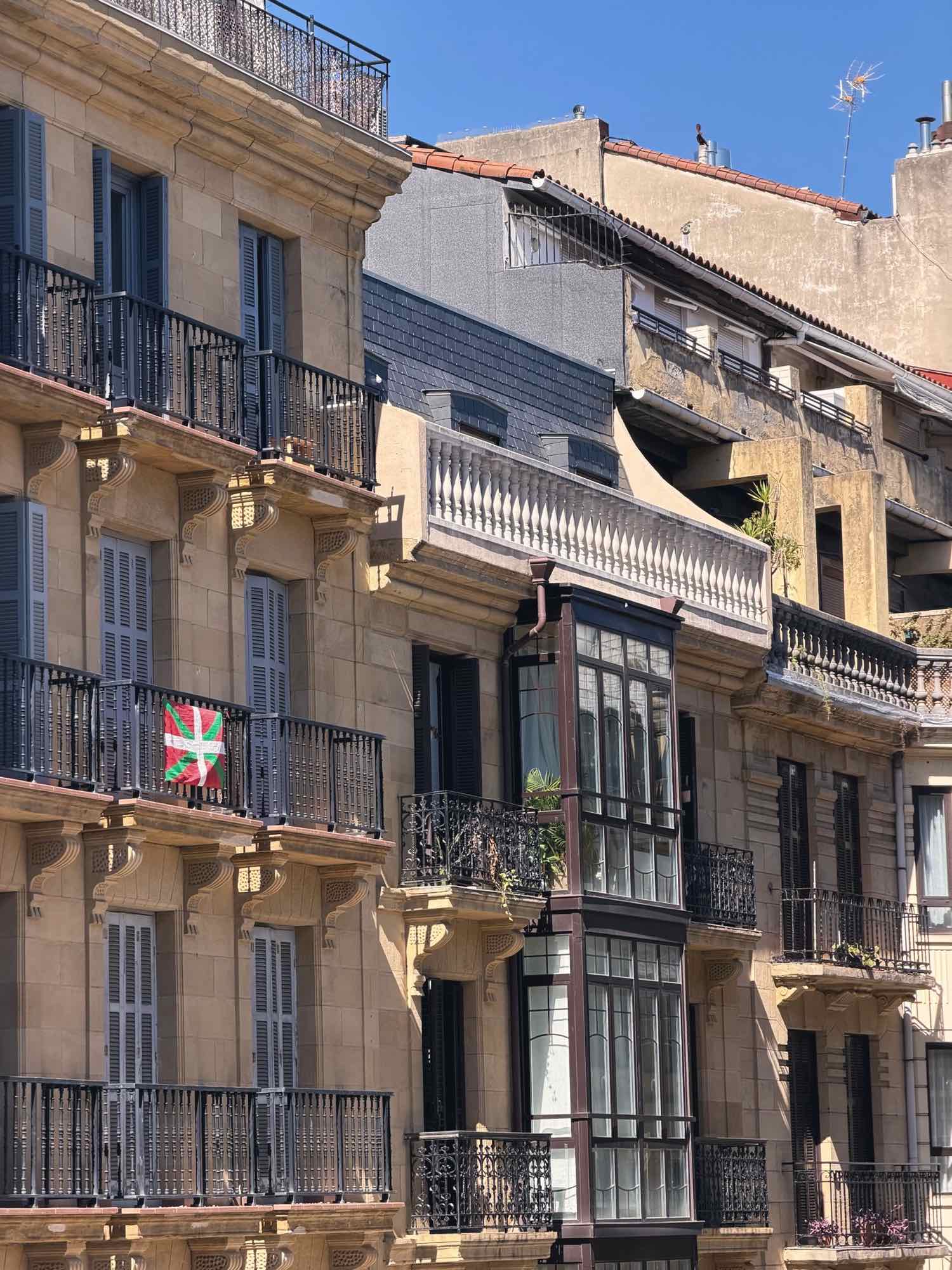
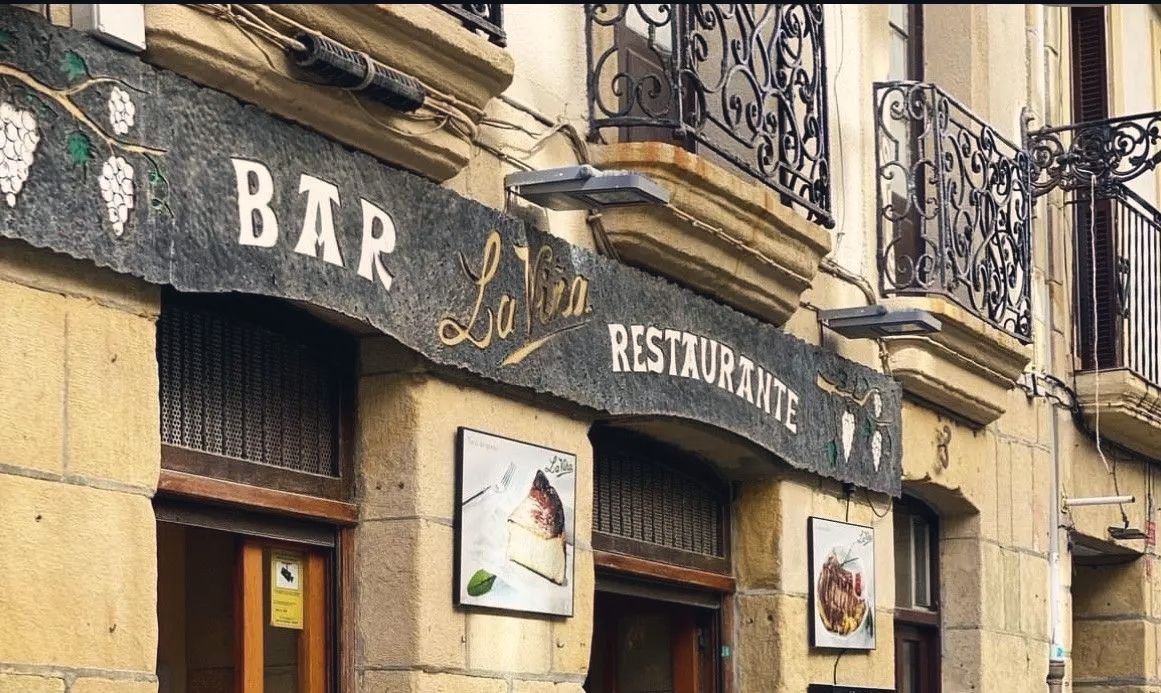
La Viña sits on Calle 31 de Agosto, and the name is worth a moment. On 31 August 1813, at the end of a long siege, San Sebastián was almost entirely destroyed by fire. This street was the only one left standing. Walk it today, between sandstone façades and wrought-iron balconies hung with the red, white and green of the Basque flag, and you are walking through the oldest surviving corner of the city.
It is also, not by coincidence, the beating heart of the Parte Vieja’s food scene. Within a few hundred metres are some of the most celebrated pintxos bars in Spain, and on a warm evening the whole street becomes one long, unhurried conversation.
La Viña: a family bar with a global reputation
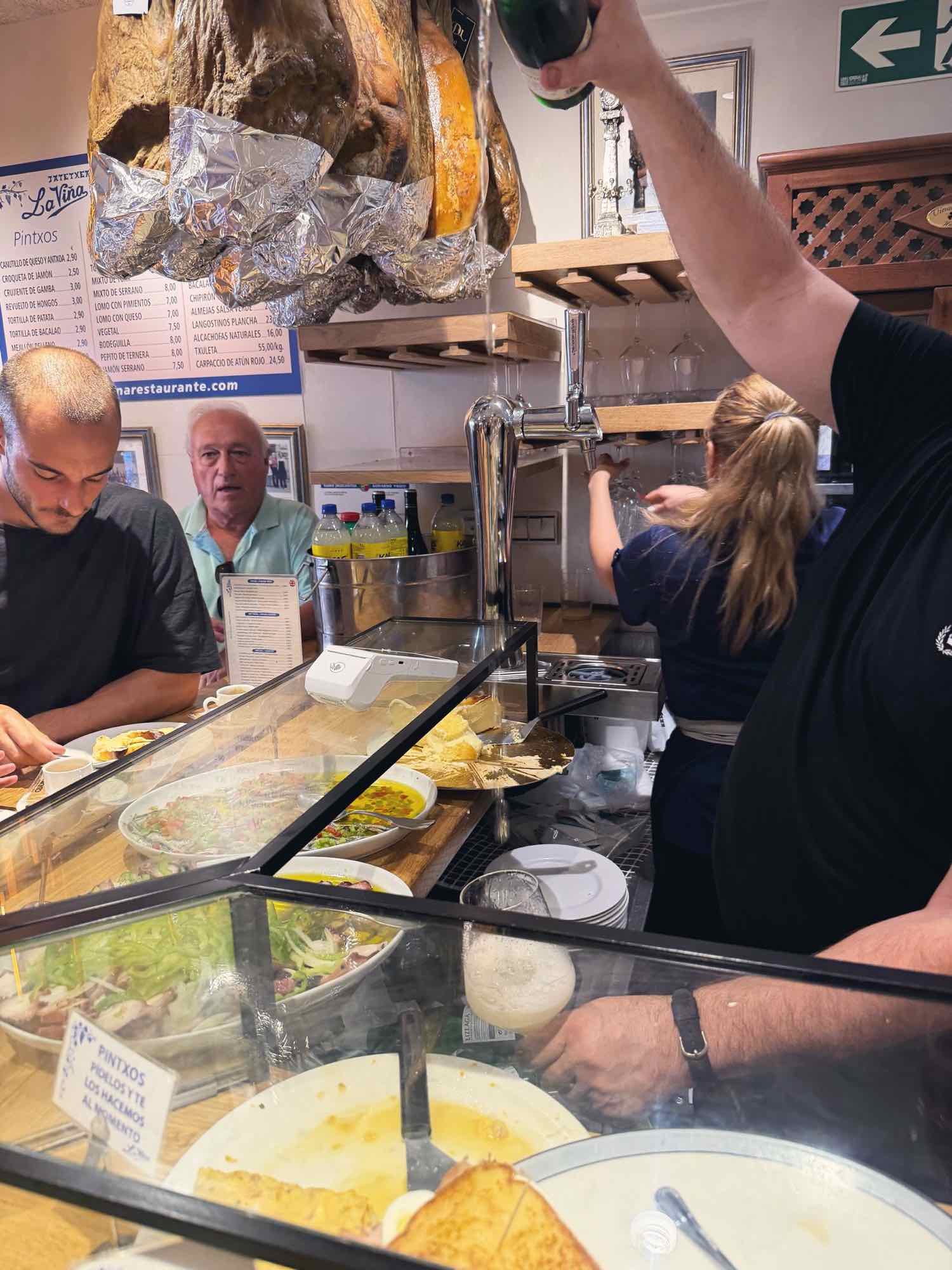
The Rivera family has run La Viña since 1959, and for its first three decades it was simply a very good neighbourhood bar. Then, around 1990, Santiago Rivera began baking a cheesecake unlike anything else on the counter. There was no biscuit base and no water bath, and no attempt at a neat, pale finish. Just cream cheese, cream, eggs, sugar and a little flour, baked in a scorching-hot oven until the top was dark and almost bitter and the centre barely set.
It should not have worked. It became a legend. Thirty-odd years later, “Basque cheesecake” is on menus from London to Tokyo, but here it is still made the same way, in the same bar, by the same family.
Step inside and the room tells you everything. Cured hams hang above the counter, wrapped in foil like gifts. Behind the bar, the staff move with the practised economy of people who have done this ten thousand times, pouring wine from shoulder height, sliding plates across the glass, calling orders back to the kitchen. Regulars lean on the counter beside first-time visitors, and nobody seems in a rush. It is loud, warm and entirely without pretension, and that is precisely its charm.
The cheesecake itself
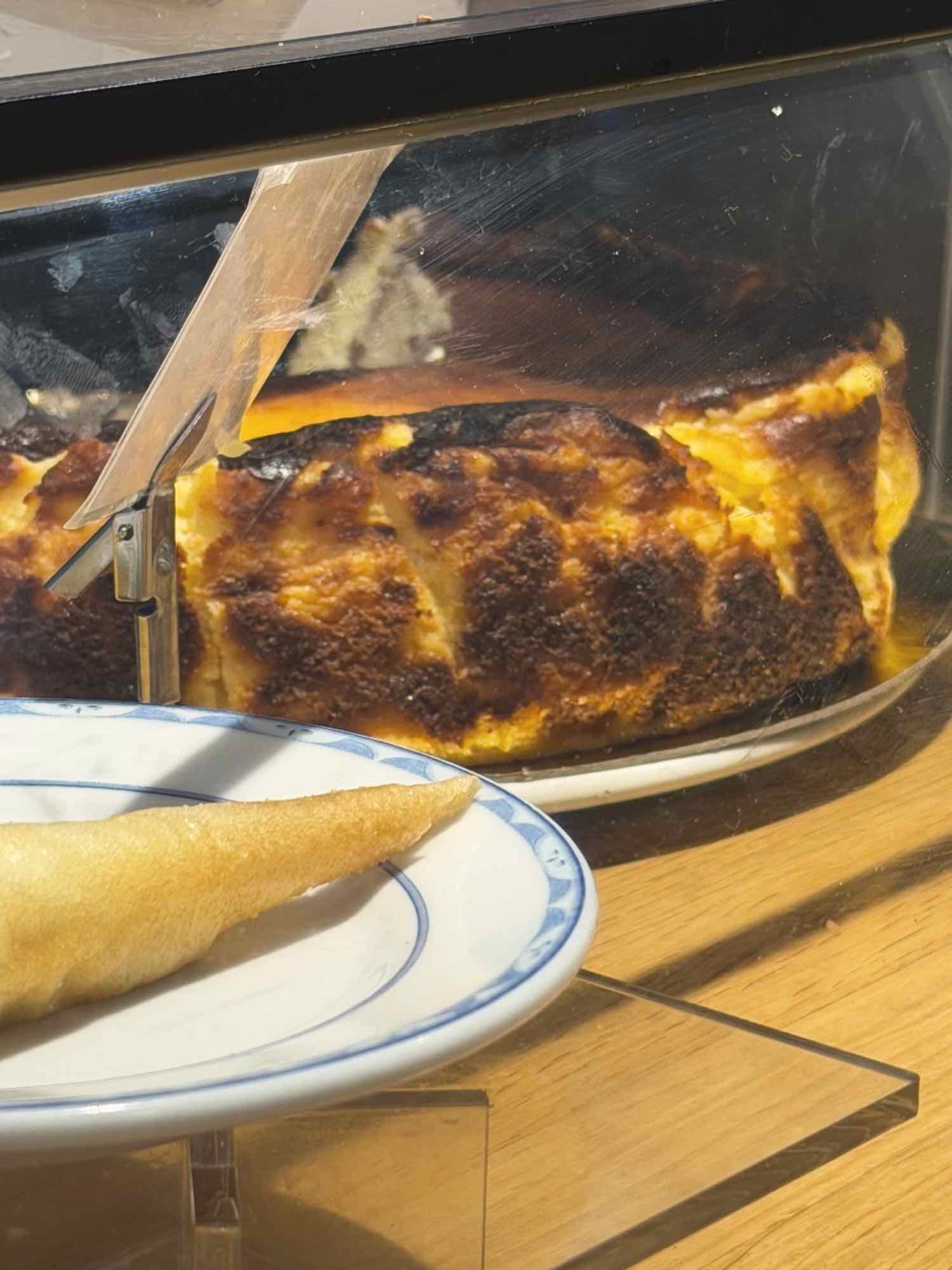
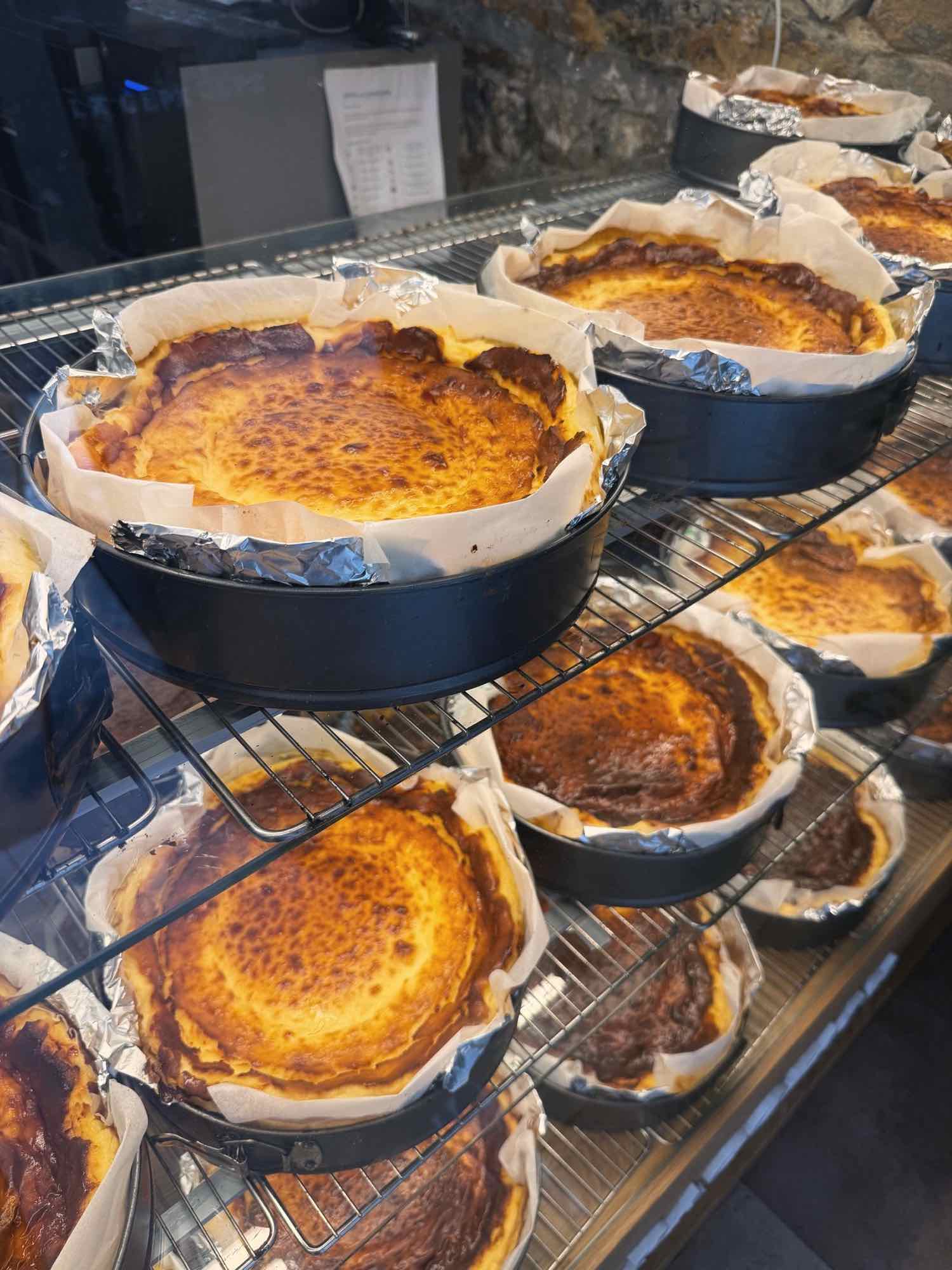
The cheesecakes sit on the counter under glass, whole and blistered, their tops a deep mahogany that edges towards black. A slice is cut to order and handed over on a plain white plate. There is no garnish, no coulis, no dusting of anything. None is needed.
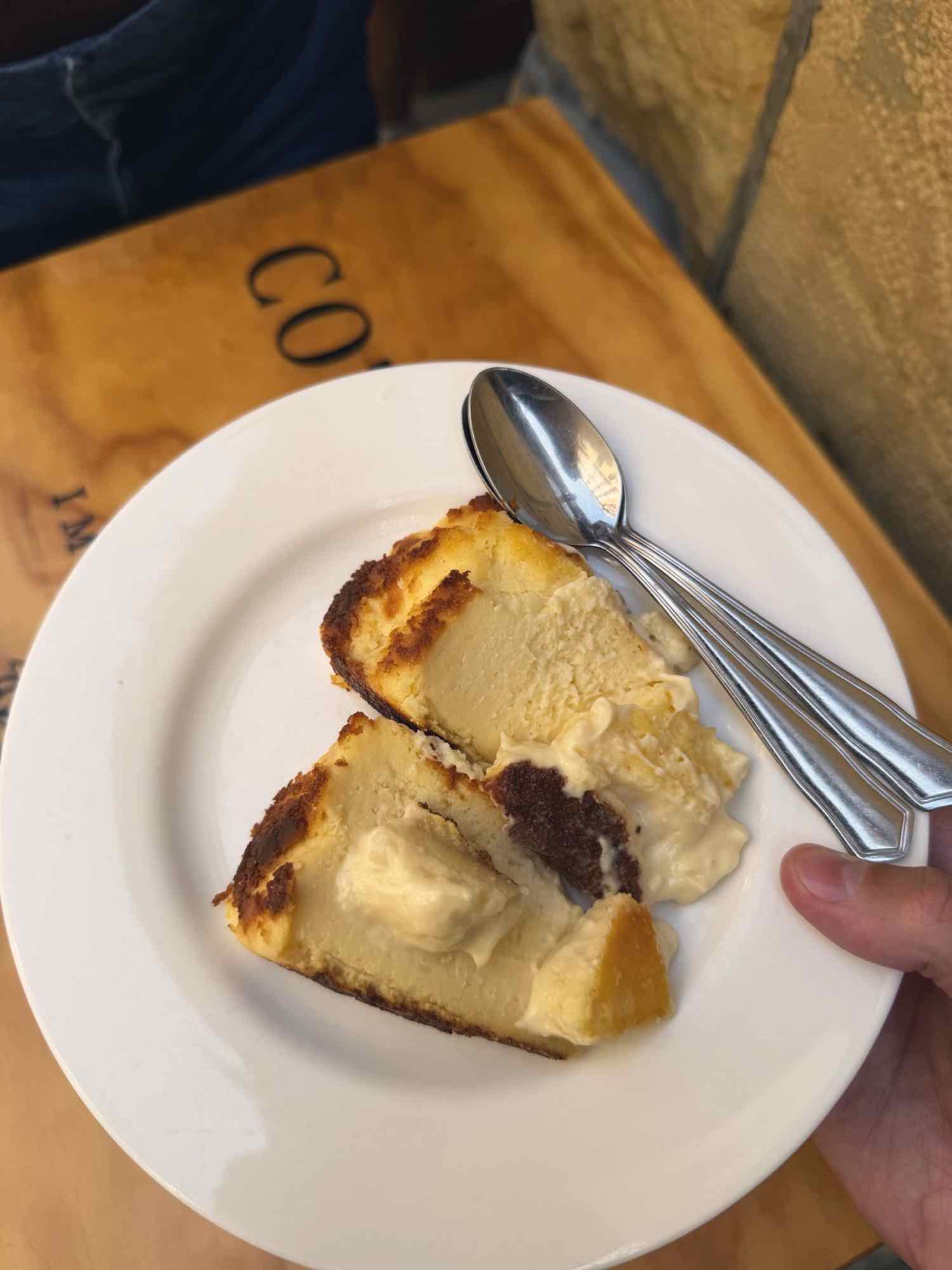
The first forkful explains the fuss. The burnt top is caramel-dark and faintly smoky, almost like crème brûlée that has been left a minute too long, in the best possible way. Beneath it, the cheesecake is impossibly soft: rich and creamy at the edges, and in the centre so loose it is closer to a custard than a cake. It is served at room temperature, never chilled, which is exactly what keeps that texture so silky. It is sweet, but not cloyingly so, with a salty, tangy depth from the cheese that makes you want another bite before you have finished the first.
How to eat it: pintxos-style, on the street
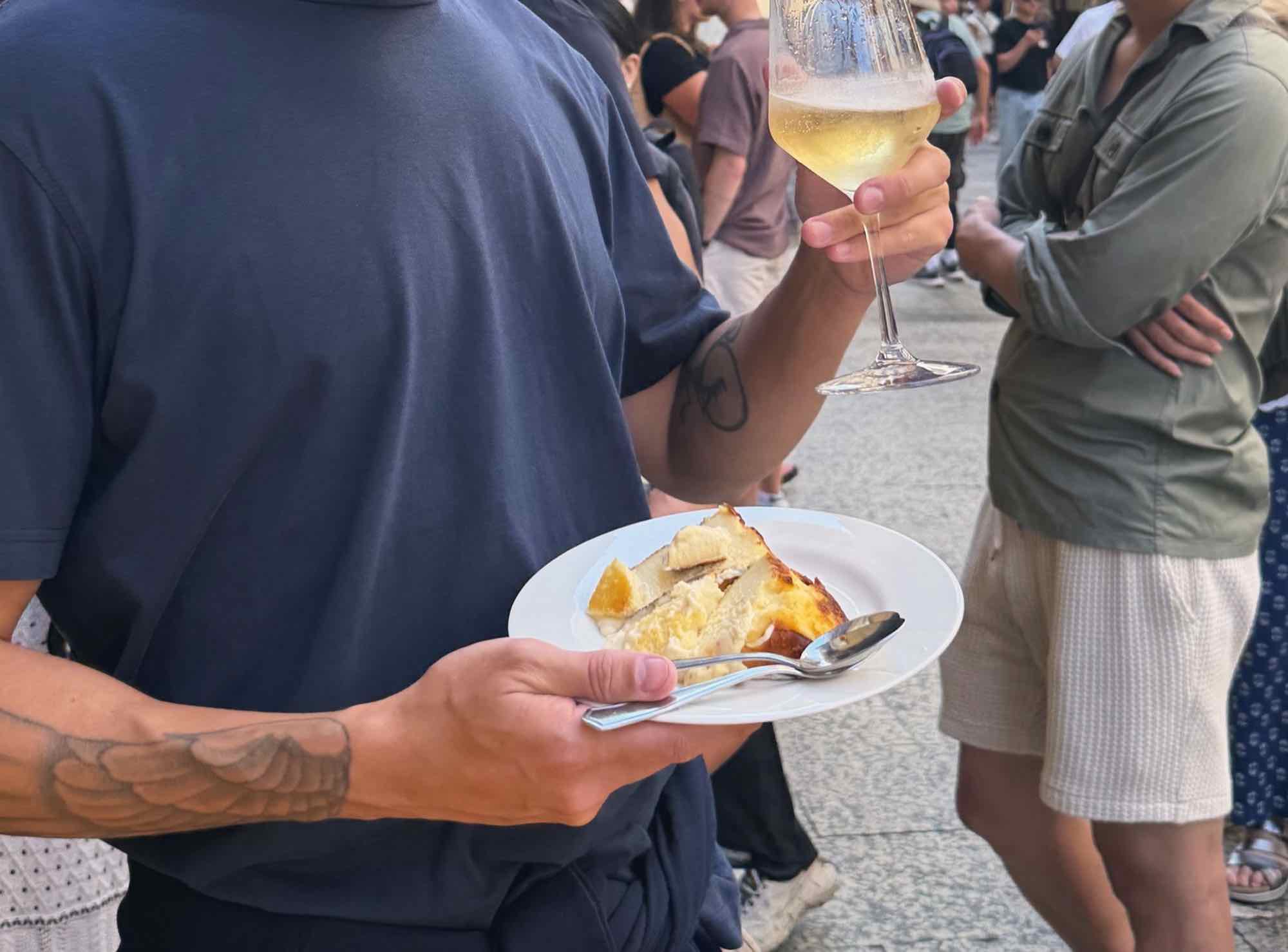
The great joy of La Viña is that you do not need a table, a reservation or a plan. San Sebastián eats standing up. You order at the bar, take your plate and your glass, and wander out into the street to join everyone else doing exactly the same thing.
We timed our visit for just before lunch, deliberately. An hour later the bar would be three deep and the street outside a happy scrum. Instead we walked straight up to the counter and ordered two slices of cheesecake and two coffees, and carried them out into the sunshine. We set them down on a wooden ledge against the old stone wall and ate slowly, watching the street fill around us. A strong, short coffee and a wedge of that cheesecake, on a cobbled street in the oldest corner of the city, is about as close to perfect as a San Sebastián morning gets.
Come back later in the day and the ritual changes. The coffee gives way to a glass of txakoli, the crisp, lightly sparkling white wine of the Basque coast, poured from a height to wake up its bubbles. Its brightness cuts straight through the richness of the cheese, and the two together, eaten in the evening sun with the street humming around you, is one of the great small pleasures of European travel.
Our tips for visiting La Viña
- Arrive just before lunch. This is what we did, and we’d do it again. The bar is at its busiest through lunch and the evening pintxos hours. Arrive in the late morning and you can order without the crush, then enjoy your slice as the street comes to life. Mid-afternoon is the next best window.
- Don’t be put off by the crowd. If there is a queue, it moves quickly. Catch the eye of the staff, order clearly and enjoy the theatre.
- Order a slice each. Portions are generous, but sharing is harder than it sounds. We ordered two slices and two coffees, and neither plate came back with a crumb on it.
- Take one home. Whole cheesecakes are usually available to take away. In high season, order a day ahead.
- Make it part of a pintxos evening. Begin with savoury pintxos elsewhere in the Old Town and finish at La Viña for dessert, the way many locals do.
So, is it the best cheesecake in Europe?
We have eaten a great many cheesecakes in our time, in Paris patisseries and New York delis and countless Basque-style imitations around Europe. None has come close. Plenty of bakeries now copy the recipe, and some do it rather well, but nothing quite matches eating the original at La Viña, in the street that survived the fire, with a glass of txakoli in hand.
So yes: in our view, the best cheesecake in Europe is in San Sebastián, at a small family bar on Calle 31 de Agosto. Go hungry, go patiently, and order two forks.
Make a weekend of it
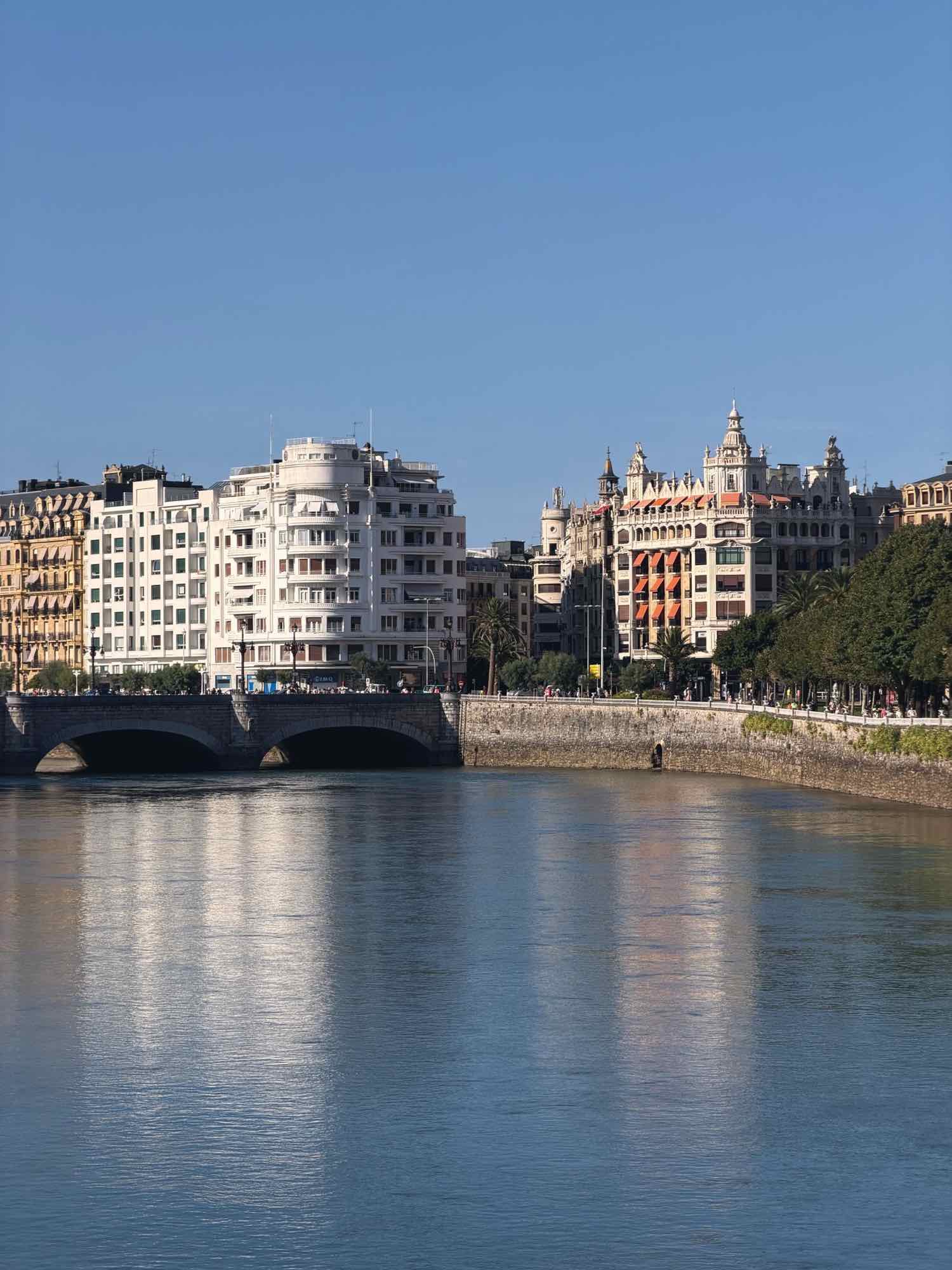
A cheesecake is a fine reason to visit San Sebastián, but it is only the beginning. This is a city of Belle Époque promenades and two of Europe’s most beautiful urban beaches, with more Michelin stars per head than almost anywhere on earth and a pintxos culture that turns every evening into a gentle, moveable feast.
We plan San Sebastián journeys around exactly these moments: a beautifully located hotel on La Concha, a table at the right restaurant, a guide who knows which bar does the best gilda, and plenty of unhurried time to wander. Tell us how you like to travel, and we will take care of the rest.
Frequently asked questions
Where is the original Basque cheesecake from?
The burnt Basque cheesecake was created at La Viña, a family-run bar on Calle 31 de Agosto in San Sebastián’s Old Town, where it has been baked since around 1990.
Is La Viña’s cheesecake worth the queue?
Yes. The queue moves quickly, and the slice you are handed is still the benchmark every other Basque cheesecake is measured against.
What is the best time to go to La Viña?
Late morning, just before the lunchtime rush, is the calmest time to order without the crowds. Mid-afternoon, between the lunch and evening pintxos rushes, is the next best window.
Can you buy a whole cheesecake at La Viña?
Whole cheesecakes are usually available to take away, but they are popular, so it is worth ordering a day ahead in high season.
What should you drink with Basque cheesecake?
Locals tend to pair it with a glass of txakoli, the lightly sparkling Basque white wine, or with a cortado in the morning.